← Back to posts
ESP32 vs Arduino: Key Differences Explained
2025-12-17
ESP32 and Arduino are popular platforms for electronics and IoT projects, but they serve different needs. This blog explains their core differences in terms of performance, connectivity, ease of use, and ideal applications to help you choose the right one.
Arduino and ESP32 are often compared, but they are not direct replacements for each other.
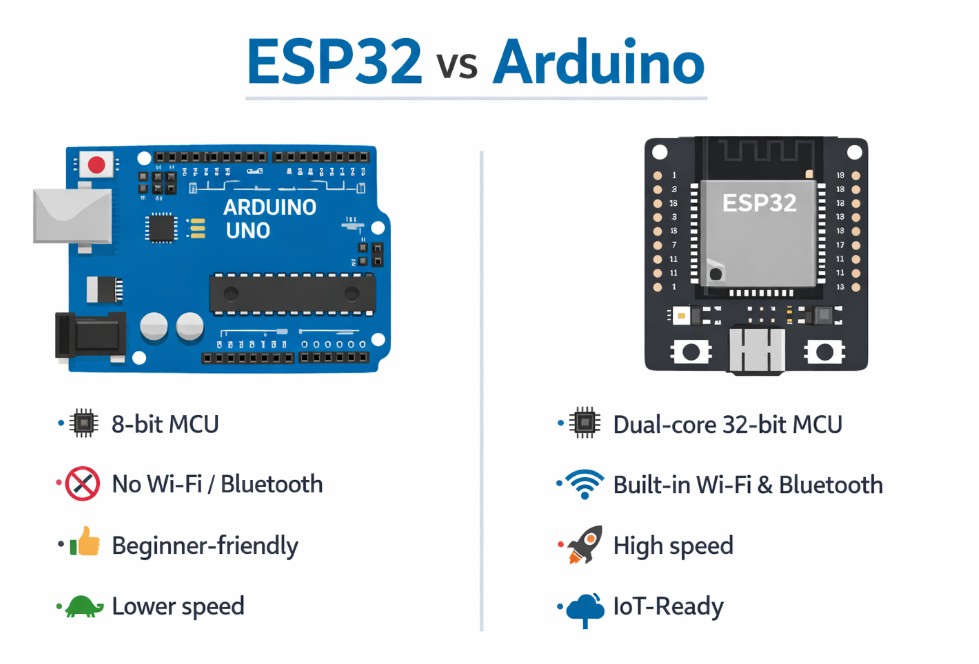
Arduino is a microcontroller platform focused on simplicity and learning. Boards like the Arduino Uno are ideal for beginners, education, and basic electronics projects. Arduino boards are easy to program, consume low power, and have a massive community with countless tutorials and libraries. However, most Arduino boards lack built-in Wi-Fi or Bluetooth and have limited processing power and memory.
ESP32, developed by Espressif, is a powerful microcontroller designed for modern IoT applications. It features built-in Wi-Fi and Bluetooth, dual-core processing, higher clock speed, and more memory. ESP32 is well-suited for smart home devices, wireless sensors, and real-time data applications. While it is more powerful, it is slightly more complex to program and debug compared to Arduino.
Key Differences at a Glance:
Performance: ESP32 is significantly faster and more powerful than most Arduino boards.
Connectivity: ESP32 includes Wi-Fi and Bluetooth; Arduino usually requires external modules.
Ease of Use: Arduino is beginner-friendly; ESP32 has a steeper learning curve.
Power Consumption: Arduino is better for ultra-low-power projects.
Use Case: Arduino for learning and simple projects, ESP32 for IoT and advanced applications.
Conclusion:
Choose Arduino if you are a beginner or working on simple hardware projects. Choose ESP32 if you need wireless connectivity, higher performance, and IoT capabilities.